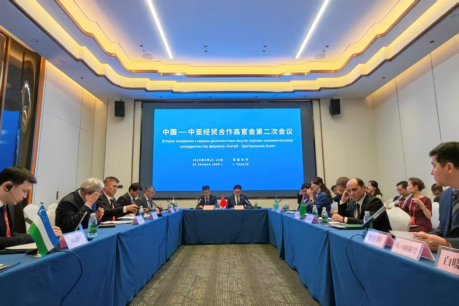
On June 25-26, the China-Central Asia Senior Officials’ Meeting on Economic and Trade Cooperation was held in Urumqi, Xinjiang. The meeting was attended by representatives from MOFCOM, competent authorities for economic and trade of Kazakhstan, Kyrgyzstan, Tajikistan, Turkmenistan, and Uzbekistan, the Secretariat of the China-Central Asia Mechanism, and relevant embassies of Central Asian countries in China. Ling Ji, Vice Minister of Commerce and Deputy China International Trade Representative, met with the representatives of all sides.
Ling Ji noted that under the strategic guidance of President Xi Jinping and the heads of state of Central Asian countries, China-Central Asia economic and trade cooperation has achieved significant progress. In 2025, the trade volume between China and Central Asian countries exceeded USD 100 billion for the first time, and investment cooperation continued to expand. Against the backdrop of severe disruptions to the international economic and trade order and rising unilateralism and protectionism, China stands ready to deepen regional economic cooperation with Central Asian countries, promote trade and investment liberalization and facilitation, strengthen cooperation on the industrial and supply chains of green minerals, expand imports from Central Asian countries, and work together to expand the pie of cooperation. China is also ready to work with all sides, on the basis of WTO rules, to jointly study and formulate institutional arrangements for regional economic and trade cooperation, and to make preparations in the field of economy and trade for the third China-Central Asia Summit.
Representatives of Central Asian countries stated that economic and trade cooperation has made positive progress since the second China-Central Asia Summit. All sides attach great importance to and are ready to actively participate in economic and trade cooperation under the China-Central Asia mechanism. They expressed readiness to actively promote cooperation in green minerals, e-commerce, capacity building, and digital trade and investment based on trust within the framework of WTO rules, so as to ensure the security and stability of regional industrial and supply chains. All sides agreed to explore concrete pathways to liberalize and facilitate trade and investment. (Released on June 29)